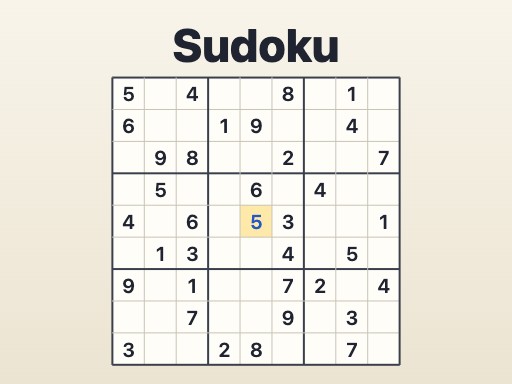
Description
This is a clean, free Sudoku that runs in your browser. Choose the daily puzzle or one of four difficulty levels, tap a square and fill in digits until the grid is complete. Every puzzle is checked before you see it so that it has exactly one solution, which means each one can be solved by logic alone.
The rule in one sentence
Each row, each column and each of the nine 3×3 boxes must contain the digits 1 to 9 exactly once. The digits printed in bold at the start are fixed clues. Everything else is yours to fill.
Daily puzzle and difficulty levels
The Daily puzzle is built from the date, so everyone who opens the game on the same day gets the same grid, and a new one appears at midnight on your device. The other modes make a fresh puzzle each time you press New. The levels differ by how many clues you start with:
- Easy: 40 clues.
- Medium: 33 clues.
- Hard: 28 clues.
- Expert: 25 clues.
- Daily: 31 clues.
Fewer clues usually means longer chains of reasoning, though the clue count alone does not decide how hard a particular grid feels.
Tools that help without spoiling it
- Notes let you pencil small candidate digits into a square. When you place a digit, the same digit is removed from the notes in its row, column and box automatically.
- Highlights shade the row, column and box of the selected square and mark every other copy of its digit, which makes conflicts easy to spot.
- Mistakes are shown in red and counted at the top. A wrong digit is never accepted as part of the solution.
- Undo steps back through your moves, notes included.
- Hint fills in the selected square, or the empty square with the fewest possibilities if none is selected.
- Each number button shows how many of that digit are still missing, and it greys out once all nine are placed.
Your game is saved in the browser as you play, with one save for each mode, so you can close the tab and continue later on the same device.
A simple way to start any grid
Pick one digit, for example 7, and look at each 3×3 box that does not yet have a 7. Rows and columns that already contain a 7 rule out squares in that box. When only one square is left, that is where the 7 goes. Sweeping through all nine digits this way fills a surprising part of an Easy grid.
When a box has two or three possible squares for a digit, use Notes. Then look at single squares: if a square's row, column and box already contain eight different digits, the ninth is the only option. Alternating between these two views, digit by digit and square by square, solves most Medium puzzles.
When you get stuck on Hard and Expert
Look for pairs. If two squares in the same row can only hold 4 and 9, then no other square in that row can be 4 or 9, even though you do not yet know which is which. Removing those candidates from the rest of the row often unlocks the next step. The same idea works for columns and boxes.
Another useful check: if every possible square for a digit inside one box lies on the same row, that digit cannot appear elsewhere in that row outside the box. Expert grids regularly depend on this kind of elimination.
Controls
On a phone or tablet, tap a square and then a number below the grid. On a computer you can also type: 1 to 9 to enter a digit, 0 or Backspace to erase, N to switch Notes on or off, Z to undo, H for a hint and the arrow keys to move. The layout resizes to fit any screen and follows your device's light or dark setting.
Made with open-source code
The puzzles start from full grids made by the open-source sudoku.js library (MIT license). The WebGame.fun team added the clue removal with its single-solution check, the daily puzzle, notes, hints, autosave and the interface. The complete source is on GitHub.
For more logic games, try our own Lantern Links, the number-merging 2048, or browse all puzzle games.







Comments