Description
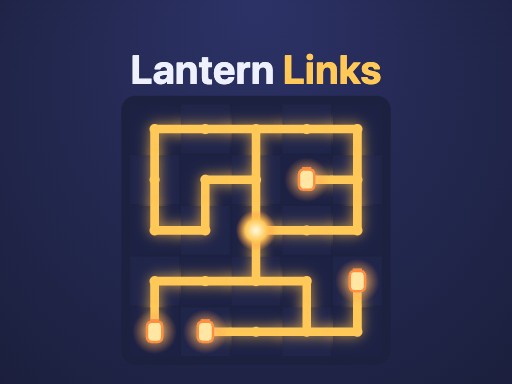
Lantern Links is a puzzle made by the WebGame.fun team, and this site is its home. A glowing core sits near the middle of the board, and every other square holds a piece of pipe: a straight run, a bend, a three-way junction or a lantern at a dead end. The pieces start turned the wrong way. Your job is to rotate them until light flows from the core through every tile and every lantern glows.
How a level is won
A level counts as solved only when the whole board is lit, not just the lanterns. The counter at the top shows how many lanterns are glowing, but a lantern can light up while a few tiles elsewhere are still dark. When the last tile joins the network, the board stops accepting moves and the next level is offered.
There is a useful consequence of that rule. In a finished board, every pipe end meets another pipe end, nothing points at the border, and the network never closes into a ring. If you see a loop, or a pipe that runs into a wall or into the flat side of a neighbour, that part is still wrong.
Controls
- Mouse or touch: tap or click a tile to turn it a quarter turn clockwise. On a computer, right-click turns it back.
- Keyboard: the arrow keys move a highlight around the board, and Space or Enter rotates the highlighted tile. Hold Shift to rotate counter-clockwise.
- Restart level scrambles the same layout into a new starting position. Level ◀ and Level ▶ move between levels if you want to skip ahead or replay one.
Start at the edges
The border does most of the thinking for you. A pipe can never point off the board, so tiles along the edge have far fewer correct positions than tiles in the middle:
- A bend in a corner can face only one way: into the board on both of its open sides.
- A three-way junction on an edge has a single correct position, with its flat back against the wall.
- A straight piece on an edge must run along that edge, never across it.
Fix these first, then work inward. Each settled tile tells you whether its neighbour must point toward it or away from it, and the answer often spreads across a whole row.
Lanterns are dead ends
Every lantern has exactly one opening. That makes them easy to reason about: a lantern must point at a neighbour that has a pipe end facing back. Two lanterns can never point at each other, because that pair would form a tiny island cut off from the core. Many lanterns sit on the edges of larger boards, so the edge-first approach often settles them early.
Count the openings
When you are stuck, look at a single tile and ask which of its four sides can connect. A side that faces the border, or faces a neighbour that is already settled with its flat side toward it, is closed. If a tile has only as many open sides as it has pipe ends, its position is decided. Repeat that check around the stuck area and the next move usually appears.
Levels that grow with you
The first levels use a 4×4 board with a handful of lanterns. Every three levels the board grows by one row and one column, up to 10×10, and the number of lanterns rises with it. There is no last level.
Each level number always produces the same puzzle, so level 12 on your phone is the same layout as level 12 on a friend's laptop. Your current level and your best move count for each level are saved in your browser, so you can close the tab and continue later on the same device. Clearing your browser data resets that progress.
Made here, open source
Lantern Links was written for WebGame.fun as a single small web page with no downloads, sign-up or tracking. It runs on phones, tablets and computers. The full source code is public under the MIT license on GitHub, where you can see exactly how the levels are built: each one is a randomly grown network of pipes that reaches every square without loops, which is why every level has a solution.
If you enjoy logic puzzles like this, browse more in our puzzle games, or try 2048 for a different kind of planning.




Comments