Mahjong solitaire looks like a matching game, and the rules fit in two sentences. Then you reach a board with no moves left and wonder what you did wrong. The answer is almost always the same: you removed a pair that looked harmless and cost you a tile you needed later.
This guide explains how to play mahjong solitaire from the first click. It covers the rules, exactly which tiles are free, and a way of choosing pairs that comes with reasons instead of slogans. Four diagrams show the positions that matter most.
The goal and the tile set
You play alone. You pick two identical free tiles each turn and they leave the board together. You win when the board is empty, and you stall when tiles remain but no matching free pair does.
A full set has 144 tiles, and many games use fewer on easy settings. The set is easier to read once you split it into groups:
| Group | What is in it | Copies of each tile |
|---|---|---|
| Three suits | Bamboo, circles and characters, numbered 1 to 9 | 4 (108 tiles in all) |
| Winds | East, south, west, north | 4 each (16 tiles) |
| Dragons | Red, green and white | 4 each (12 tiles) |
| Seasons | Four different pictures | 1 each, but any season matches any other season |
| Flowers | Four different pictures | 1 each, but any flower matches any other flower |
Count it up and you get 36 sets of four tiles that can pair with one another: 34 ordinary kinds, plus the seasons as one set and the flowers as another. That number matters later. Some tile styles swap in other pictures, such as cartoon food, but the logic is the same.
One note on sources: most rule summaries agree that seasons and flowers match within their own group, but a few games skip that and use identical copies only. Check the help screen of the version you play.
Which tiles are free
This is the rule that most guides blur, so here it is in full. A tile is free when both of these are true:
- Nothing is on top of it. No tile on a higher layer rests on it.
- At least one long side is open. Either the left side or the right side has no neighbouring tile at the same level. One open side is enough. It does not need to be both.
Think of sliding the tile sideways out of the pile. If it can slide out left or right without touching anything, it is free. If another tile would have to move out of its way, it is not.
Wording varies between websites, and some versions mislead. One popular description says "one or both sides", and another skips the top rule. The version above is the standard one. It matches the in-game instructions of Mahjong Tasty Pairs: a tile is available when no tile covers it from above and it is not blocked on both side edges at once.
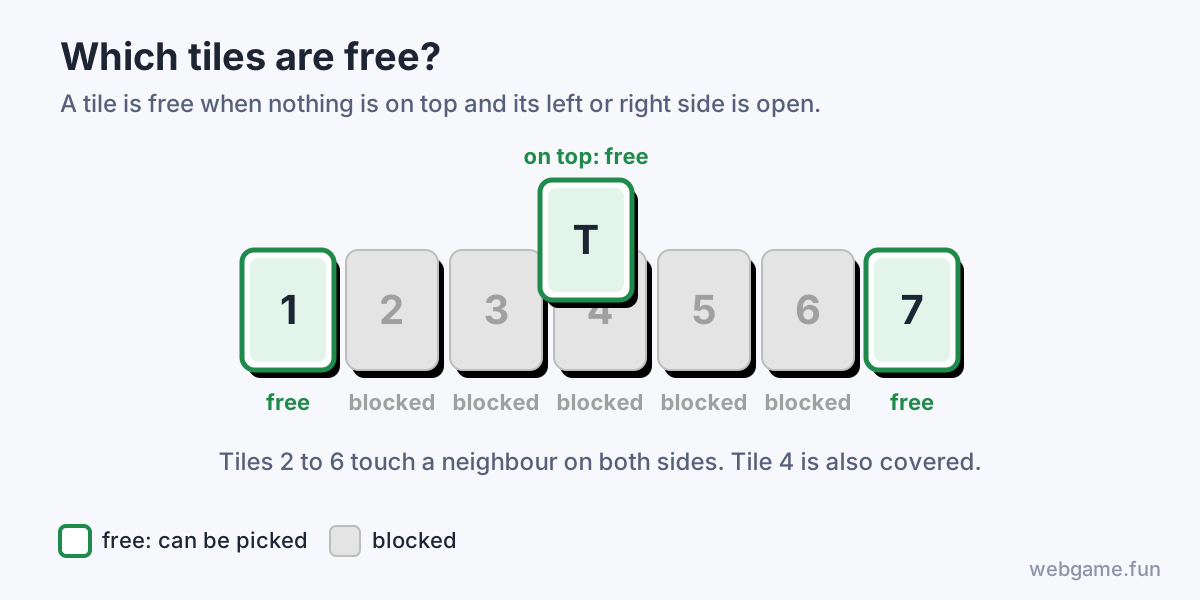
Take a single row of seven tiles with one extra tile sitting on the fourth tile. The first and seventh tiles are free, because each has an open outer side and nothing above it. The extra tile on top is free too, since it has air on both sides and nothing above it. The other five are blocked: tiles two, three, five and six have neighbours on both sides, and the fourth has neighbours on both sides plus a tile on its back.
Two things catch beginners: a tile with an open side is still blocked if something sits on top of it, and a neighbour on only one side does not block a tile.
Layouts differ on tiles offset by half a position, and some count them as touching. If a game dims blocked tiles, as Mahjong Tasty Pairs does, use the dimming as the final word.
Reading the layers
The classic shape is a pile of up to five layers, wide at the bottom and narrow at the top. From above you cannot see how many tiles share a column.
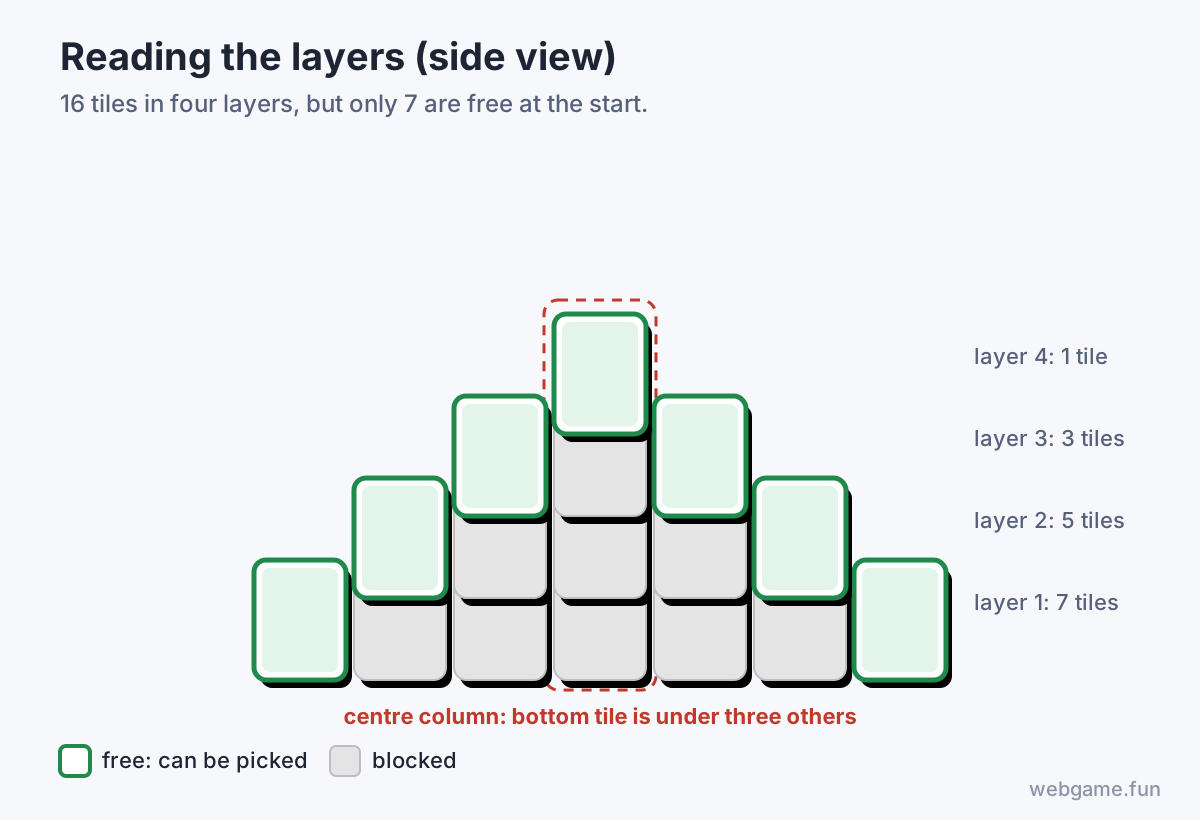
Picture a pyramid seen from the side: seven tiles on the bottom layer, five on the second, three on the third, and one on top. That is 16 tiles. Only seven of them are free at the start: the single top tile, the two ends of each of the second and third layers, and the two ends of the bottom layer. The other nine are covered or boxed in. The tile in the exact middle of the bottom layer has three tiles stacked over it, so it cannot move until all three are gone.
Tall columns hide the most tiles, and a long row is a queue with doors only at its two ends.
Two moves that are always safe
Removing a free tile never makes another tile harder to reach. A removal can only uncover or open things, and nothing lands on a tile later. So the only way to lose is to pair the wrong tiles. Once you know which tile goes with which, you can take the pairs in any order the board allows.
1. Four free copies: take them all
If all four copies of a picture are free at the same moment, remove them as two pairs straight away. It does not matter which tile goes with which, because all four disappear and nothing is left to be stranded.
2. After the first pair of a kind, take the second as soon as you can
Once one pair of a picture is gone, only two copies are left, and those two have exactly one possible partner each. With no choice left, the moment both are free, remove them. This also works for seasons and flowers, which behave like any other set of four.
The pairing choice only exists at the first pair of each set of four, so spend your thinking time there. A full board has 36 such sets, each pairable three ways, which is roughly 150 quadrillion possible pairings in all. A rule of thumb beats brute force.
Three copies in view: which pair to take
Three of the four copies of a picture are free, and you must pick two. The fourth is hidden or blocked, and whichever tile you leave behind has to wait for it.
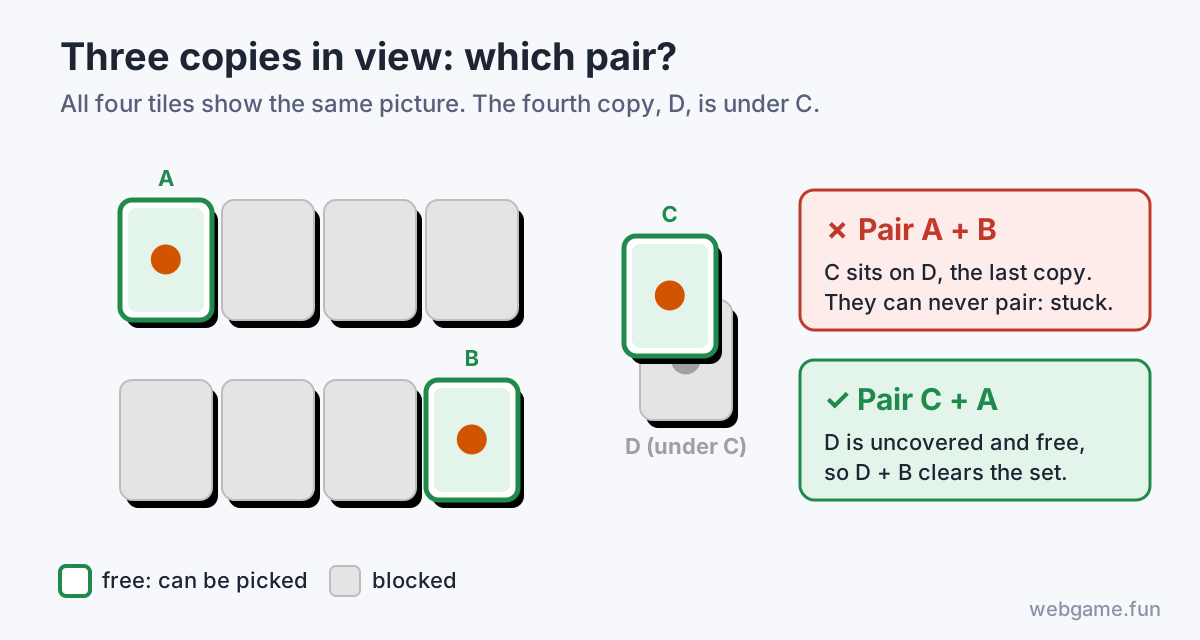
Here is a concrete case. Call the four copies A, B, C and D.
- A is free at the left end of the top row.
- B is free at the right end of the bottom row.
- C is free as the top tile of a two-tile stack in the middle.
- D is the tile directly under C.
You can pair A with B, A with C, or B with C. Two of those are fine and one loses the game.
If you pair A with B, you are left with C sitting on D. C needs a free partner, and its only partner is the tile it is covering. D cannot move until C is gone, and C cannot go until D is free. Neither can ever be removed.
If you pair C with A (or C with B), the stack opens up. D becomes free the instant C leaves, and D pairs with the remaining copy at leisure. Two stacked identical tiles must each go with a different outside partner, and the top one always goes first.
The general rule is: never leave two identical tiles with one sitting on the other as your last pair of that picture. The same applies if three copies are stacked in one column. Whatever you do, the last two end up on top of each other, so such a deal cannot be won.
When no stack is involved, ask which two tiles free the most others, and which tile is safest to leave behind. A tile that is already free stays free for the rest of the game, so leaving it as the survivor costs nothing.
Long rows and the ends that matter
Many strategy guides say to clear long rows first. It is rarely backed with a reason, and the numbers say it should not be your main rule.
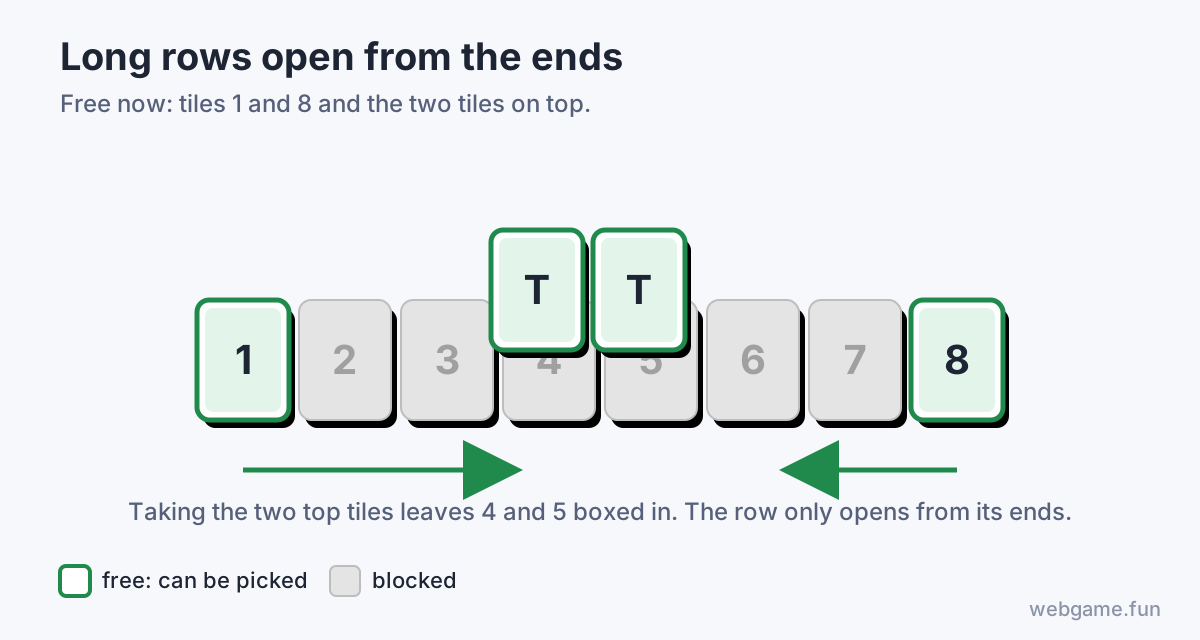
Take a row of eight tiles at one level, numbered 1 to 8 from the left, with two extra tiles on tiles 4 and 5. Tiles 1 and 8 are free, and so are the two on top. Remove the top pair and tiles 4 and 5 are uncovered, but tiles 3 and 6 still hem them in. The only way into the row is through its ends: tile 1 before tile 2, tile 2 before tile 3. Eight tiles take at least four turns, and each turn needs a partner for the next end tile.
One published simulation tested several common rules on the classic turtle layout with random deals, each combined with the two safe moves above:
| Rule used to pick pairs | Win rate (no look-ahead) | Win rate (3 moves ahead) |
|---|---|---|
| Pick pairs at random | about 5.9% | not tested |
| Maximise available tiles | 11.2% | 13.9% |
| Maximise available moves (pairs) | 13.7% | 18.6% |
| Work only on the longest row | 6.9% | 10.1% |
| Shorten all rows, longest first | 4.3% | 7.0% |
| Reduce pile height | 5.4% | 7.1% |
These come from one study on one layout, so treat the percentages as a rough guide. The pattern is clear, though. Counting the pairs you will have available after your move beat every row-based or height-based rule, and rules built only on row length or pile height did no better than random pairing, or barely better. Combining the rules, with moves available first, tiles available second and row length last, reached 16.8% with no look-ahead and 24.1% looking five moves ahead.
That fits the logic of the game. Row length is a symptom. What really kills a board is running out of free pairs, and the best way to avoid that is to count free pairs directly. Use the long-row idea as a tie-breaker: if two moves leave you with the same number of options, take the one that opens a row end or strips a tall column.
A move-choosing routine you can use every turn
- Take free gifts. Four free copies, or a second pair of a kind that is now complete: take them at once.
- Check for stacked twins. If two identical tiles sit one on top of the other, make sure the top one goes with a different partner.
- Count the pairs you will have after each candidate move. Pick the move that leaves the most pairs available.
- Break ties by what you uncover. More newly freed tiles is better. Opening the end of a long row is better than freeing a tile that already had many neighbours.
- Delay moves that open nothing. A pair that frees no new tile and removes no key blocker can wait. It will still be there later.
- Watch for lonely tiles. If you can see two copies of a rare picture and both are deep in a column, work toward them before you run low on other moves.
Can every deal be won?
No, and it helps to know why. In a game that shuffles the tiles at random, some deals cannot be solved. The clearest case is three copies of one picture stacked in a single column, as described above. There are subtler traps too, where several tiles hold each other in place.
The same simulation study estimated that at least 96% can be solved by some sequence of pairs. That is a lower-bound estimate, not a proof. Finding that solution without planning is much harder, which is why the win rates above are so low.
Some games build the layout in reverse, placing tiles in matching pairs so playing them backward always clears the board. Others use stored deals chosen for difficulty. A purely random deal promises nothing. Mahjong Tasty Pairs describes its layouts as procedurally generated, but its page does not say every stage is solvable, so do not assume it either way.
If you lose a deal and the final position shows two stacked twins or three copies in one column, the deal was probably unwinnable.
When you are stuck: undo, hint, shuffle
Most digital versions give you three tools.
- Undo is the best learning tool. Back up to the last decision where you had a real choice, and try the other pair.
- Hint shows a legal pair. It is not always the best pair, so run your own count before trusting it, especially when three copies are in view.
- Shuffle rearranges the tiles that remain. It can break a deadlock, but it changes the deal you started with, so some players do not count a shuffled win. Treat it as a last resort.
Mahjong Tasty Pairs offers all three. According to its page, you can shuffle, undo the last pair, or ask for a hint, and tiles that are blocked appear dimmed so open tiles stand out. It has 300 stages with procedurally generated layouts, awards up to three stars per stage, and has a leaderboard.
For related practice, Memory Match Game trains tile-location memory: matched tiles leave the screen while a timer runs. Magic Match Game is a color-clearing puzzle where scanning the whole grid before each click pays off. You can find more of these in the puzzle category.
Frequently asked questions
Why can I not click a tile that has nothing on top of it?
It is probably hemmed in on both sides. A tile needs at least one open side, left or right, as well as a clear top.
What happens when no pairs are left?
The game is over unless the version offers undo or shuffle. Undo lets you retry an earlier choice. Shuffle rearranges what remains, but it replaces the deal you started with.
Do seasons and flowers need identical partners?
In the traditional set, no. Any season matches any other season, and any flower matches any other flower. Some games treat them as ordinary tiles, so check the rules screen.
Is the best strategy to clear the longest rows first?
Not by itself. Long rows are worth opening, but one simulation found that choosing the pair that leaves the most available pairs does far better. Use row length to break ties.