Brick breaker games look like pure reflexes: move the paddle, keep the ball alive, wait for the wall to fall. Play a few levels, though, and you notice that the same handful of habits decides almost every board. Where you hit the ball, when you go for a power-up and how you deal with the last two or three bricks matter far more than fast hands.
This guide walks through those habits. The examples use Many Bricks Breaker, a free brick breaker you can play in the browser with two modes, Classic and Many Bricks, and 100 levels in each. The ideas work in nearly any game of this type.
How a brick breaker game works
The rules fit in one line: bounce a ball off your paddle and break every brick on the screen without letting the ball fall past you. You move the paddle left and right along the bottom. The ball rebounds off the side walls, the ceiling and the bricks themselves. Some broken bricks drop power-ups that you catch with the paddle. Clear the board and the next level starts.
The idea goes back to the arcade era in the 1970s, and later games added falling capsules and stronger bricks. Almost every modern version still uses the same base, so a skill you learn in one carries over to the next.
Tip 1: The paddle is a steering wheel, not a wall
The most useful thing to know about this genre is that the ball does not simply bounce off the paddle like a mirror. In most brick breaker games, the spot where the ball touches the paddle decides where it goes next:
- Centre of the paddle: the ball goes close to straight up.
- Between centre and end: it leaves at a moderate angle.
- Near the ends: it leaves at a sharp, low angle toward the side wall.
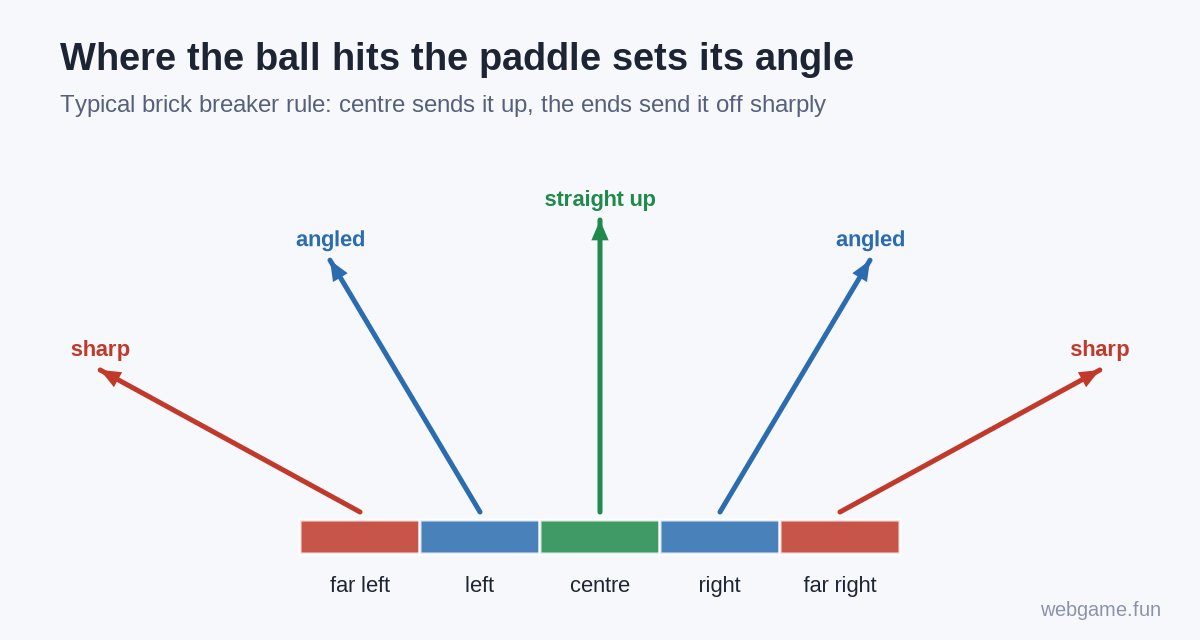
Once you know this, you stop reacting and start choosing. Before the ball comes down, look at the board and decide which zone you want it to hit. Then move early so the ball lands on that part of the paddle. Moving under the ball early also gives you time to adjust, while a last-second lunge usually ends with an edge hit you did not plan.
A simple test: for one level, try to return every ball with the centre of the paddle. The game becomes calm and predictable. Then try aiming with the ends on purpose. You will feel how much control the angle gives you.
Tip 2: Get the ball behind the wall
The best moment in any brick breaker game is when the ball slips through a gap and ends up above the bricks. Up there, it rebounds between the ceiling and the top of the wall, and each bounce down can break another brick while you simply wait below.
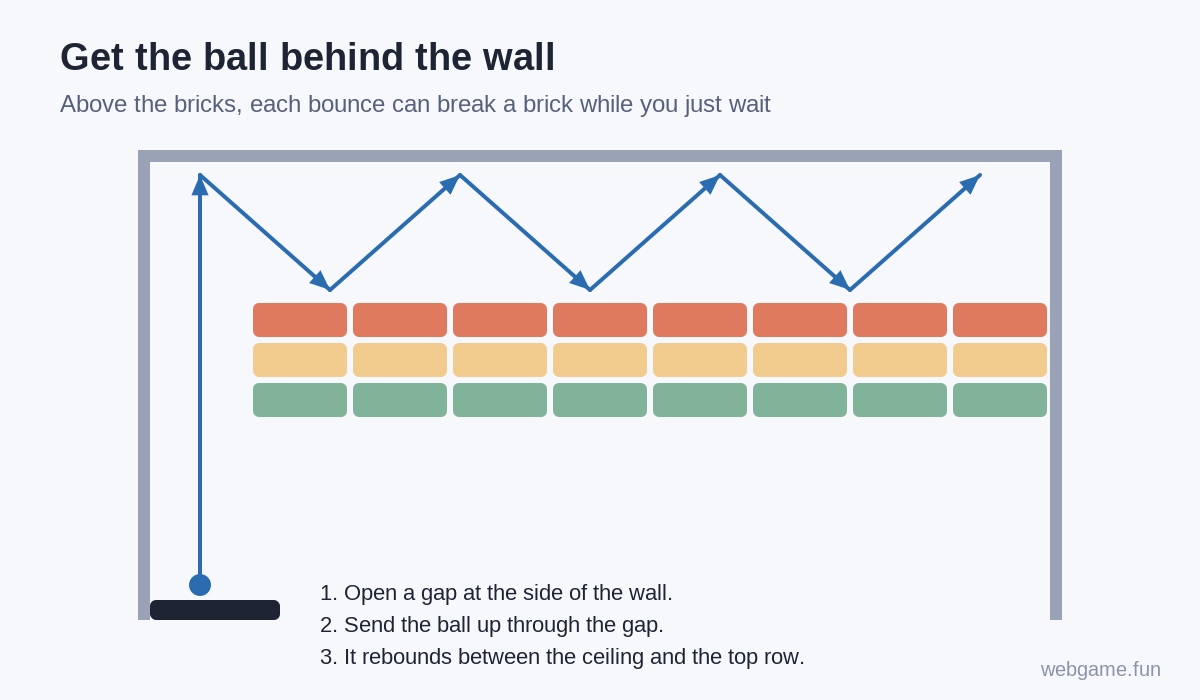
You can set this up on purpose:
- Pick one side. Aim at the bricks next to a side wall, using the paddle ends to send the ball there at a sharp angle.
- Dig a column. Keep hitting the same area until there is a gap from the bottom row to the top.
- Thread the gap. Once the column is open, a ball that travels up along the side wall goes straight through.
While the ball is up there, stay roughly in the middle and watch for it to come back out. When it does, it can drop at an odd angle, so do not relax too early.
Tip 3: Watch the ball, not the bricks
On busy boards it is tempting to look at the bricks to see what breaks next. That is how most balls get lost. Your eyes should follow the ball, and the bricks should only be at the edge of your view.
This matters more in fuller layouts. In Many Bricks Breaker, the name of the Many Bricks mode suggests busier boards than Classic, and more targets usually mean more rebounds to track. If you are new to the game, start with Classic until following the ball feels natural, then move on.
Tip 4: Catch power-ups only when it is safe
Power-ups fall from broken bricks, and they can make a level much easier. But each one you chase pulls the paddle away from where the ball is going. A good rule:
- Go for a power-up when the ball is high on the screen or moving away from you.
- Let it fall when the ball is already on its way down.
- If you are unsure what a capsule does, it is still not worth losing the ball for.
Losing a ball costs much more than missing one bonus, so when in doubt, stay with the ball.
Tip 5: How to finish the last bricks
The final few bricks take longer than anything else on the board. They are often in awkward spots, like a single brick tucked against a side wall or the corner of the ceiling. A few ways to handle them:
- Use the angle on purpose. A brick next to a wall is easier to reach with a medium angle that bounces off that wall than with a steep shot straight at it.
- Calm the ball first. If the ball is flying around at a sharp angle, return it with the centre of the paddle for a few hits so it settles into a predictable path. Then aim.
- Change one thing at a time. If a shot just misses, move the hit point on the paddle a little rather than trying something completely new.
- Be patient. Unless the game shows a timer, there is no reason to rush the last brick. Losing a ball because you hurried is the bigger risk.
A simple routine for every level
- At the start, return the first few balls with the centre of the paddle while you look at the layout.
- Pick a side and start digging a column toward the top.
- Get the ball behind the wall and let it work.
- Catch power-ups only when the ball is high or moving away from you.
- Slow down for the last bricks and aim with medium angles.
None of this needs fast reactions. It is mostly about deciding where the ball should go before it reaches you.
Where to play
You can try all of this right now in Many Bricks Breaker. It runs in the browser on phone or PC, with no download and no sign-up. If you enjoy aiming games, our bubble shooter tips use a similar idea of bouncing shots off the walls. For more quick reflex games, browse the arcade games on WebGame.fun.